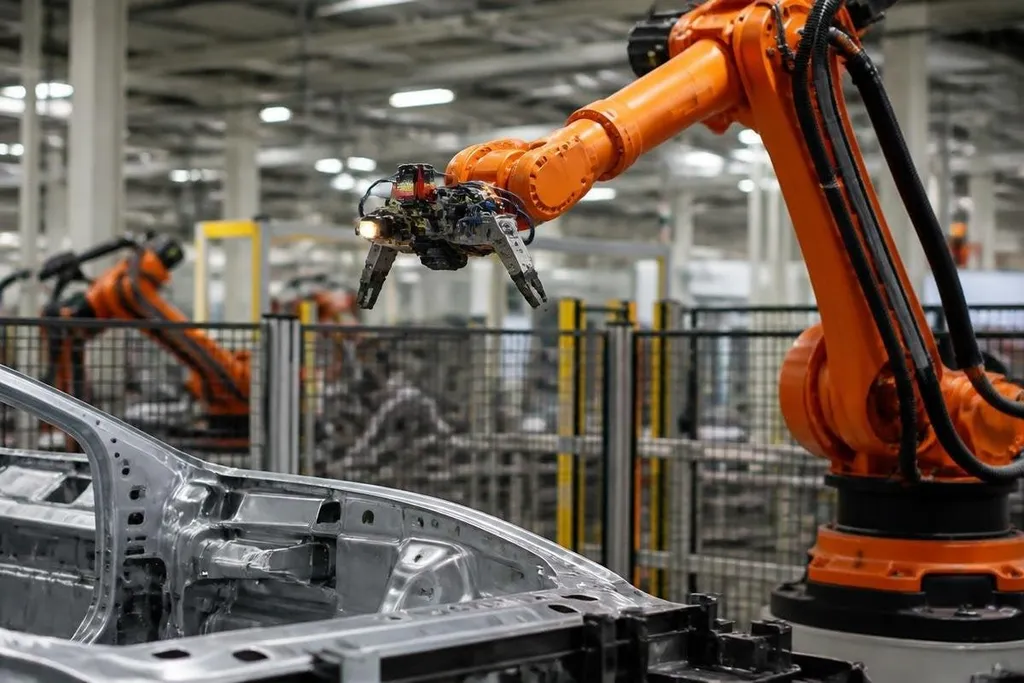
AI is changing automotive robots by helping them deal with parts that move, vary, or arrive slightly out of place. The change reaches robot arms, mobile platforms, and inspection systems, but the useful question is what the system can do after a part fails to match its stored model.
- Vision systems can locate parts without fixed placement.
- Force data can help an arm detect contact during assembly.
- The main limit is still safe, repeatable work outside the trained task.
From fixed moves to guided actions
A traditional industrial robot repeats a path programmed around known part positions. That works well when fixtures, tools, and components stay within tight limits. AI adds software that can read camera images, compare them with earlier examples, and choose a motion from the current scene.
The robot still needs motors, sensors, a controller, and a defined safety area. AI does not remove those parts. It changes how the controller handles input, so the robot can react when a door panel sits a few millimeters away from its expected position or when a bin contains parts in mixed orientations.
A vision model turns camera data into useful details, such as the location, angle, or type of a part. The robot can then move its end effector, the tool at the end of its arm, toward that part. The result depends on lighting, camera position, training data, and the grip itself.
Where the factory gains time
Automotive plants use robots for welding, painting, fastening, handling, and inspection. These jobs differ in how much variation they allow. Welding can follow a fixed path when the body structure is held in a repeatable fixture. Picking loose parts from a bin needs more sensing because each part can rest at a different angle.
AI helps most when the robot must make a small choice before it acts. An inspection system can compare a panel with an approved image and flag a mark or missing component.
A handling robot can use depth data to estimate where a part sits. A force sensor can report contact as a tool presses into a connector, which gives the controller a chance to stop or adjust.
This matters to a plant manager because model changes and mixed production can create new setup work. If one line builds several vehicle versions, software that reads part position and type may reduce the need for a separate fixed program for every small change. The time saved depends on setup rules, validation checks, and how often the line changes.
AI-guided automotive robots still have to cope with changing parts and workers on the same line. A plant manager can use Robot24.com to check those claims against named systems, plant trials, dates, and measured results before the discussion turns to mobile robots and their sensors.
Mobile robots gain a better view
Automotive factories also use mobile robots to move parts between storage, production cells, and inspection areas. A mobile robot uses sensors such as cameras or LiDAR to estimate its position and detect obstacles. AI can help classify objects in its route, but the navigation system still needs maps, speed limits, stopping rules, and marked paths.
That division matters. A model may identify a person, pallet, or loose object, while a safety controller decides whether the robot may continue moving. Treating one software model as the whole safety system would leave a gap between recognition and action.
The same problem appears in robot arms. A model can suggest a grasp, but the gripper still needs enough force to hold the part without crushing it. The factory must test poor lighting, reflective surfaces, empty bins, damaged parts, and network loss before the robot works near people.
What remains unproven
AI can reduce manual programming for some tasks, but it does not make every task ready for automation. A robot trained on clean parts may struggle with oil, glare, bent edges, or a part that differs from its examples. A change in camera position can also alter the data the model receives.
Validation takes time. Engineers need known test parts, fault cases, stop rules, and records that show why the robot acted. The plant also needs a way to return to a tested program if a software update changes the robot's behavior.
I'd choose AI first for tasks with repeatable surroundings and a clear pass-or-fail check. I wouldn't start with a task where a wrong grip can damage a vehicle or put a worker close to an unexpected motion.
A buying checklist
Before adding AI to an automotive robot cell, check these points:
- Define the task: list the part types, allowed variation, cycle time, and failure cost.
- Test the sensors: check glare, dust, shadows, blocked views, and changing light.
- Keep a safe fallback: set a tested robot program for model errors or lost data.
- Measure the full cell: include setup, inspection, stops, recovery, and operator checks.
- Plan software control: record model versions and require approval before updates.
- Set the boundary: state which cases the robot must pass to a person.
The practical test is simple: run the robot through normal parts and the failures that workers already know. If the system can explain when it stops, recover without hidden manual steps, and keep its cycle time after a model change, AI has a useful place on the factory floor. Otherwise, a fixed program may still be the better machine.